
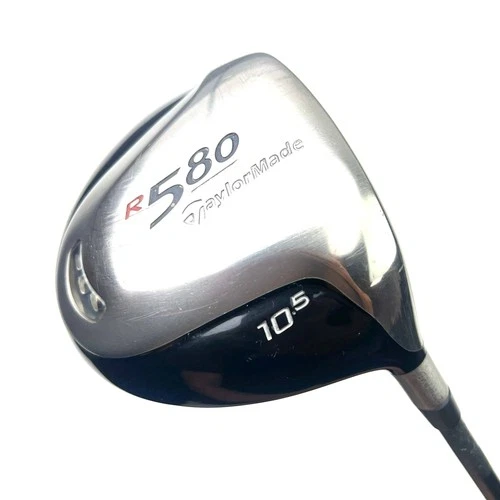
The Idea Behind Inverted Cone Technology
Before the R500, driver faces were built for maximum ball speed at the exact center of the face, and performance dropped off quickly on anything struck even slightly off-center. TaylorMade's engineers shaped the inside of the R580's face like an inverted cone, thicker in the middle and progressively thinner toward the edges, so that mishits closer to the perimeter kept more of their trampoline effect instead of losing it entirely. It was a genuinely different way of thinking about face design rather than a marketing label bolted onto an existing face, and it is the direct ancestor of the face-flexing technology every modern TaylorMade driver still uses.
The 400cc head was also a real number in 2002, not a modest one. TaylorMade pushed the R580 to the largest legal-adjacent size available at the time, years before the USGA's 460cc limit became the fixed ceiling everyone still designs to today.
What It Actually Feels Like to Hit
Play an R580 today and the two things that stand out immediately are the sound and the total lack of adjustability. The impact sound is a higher-pitched, thinner crack than any modern driver, a product of the era's steel-and-early-titanium construction rather than today's heavily engineered acoustic chambers. There is no hosel adjustment, no movable weight, no way to correct a fit problem after purchase; the loft and lie you buy are the loft and lie you play. For a golfer used to dialing in a modern driver at a fitting bay, that rigidity takes real adjustment.
What has not aged at all is the forgiveness on strikes toward the heel or toe. The inverted cone face genuinely does what it was designed to do, and a mishit an inch off-center still carries with surprisingly little ball speed loss for a 20-plus-year-old head.
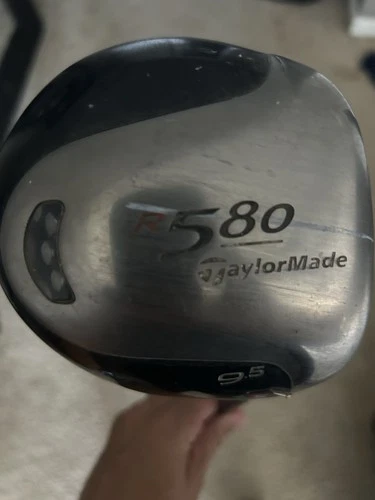
R500 vs. the Rest of the 2002 Field
The R580 did not launch into a vacuum. Callaway's ERC Fusion, released the same year, took a different approach to the same problem, combining a titanium body with a composite crown to save weight rather than reshaping the face itself. Titleist, by contrast, was still a generation away from its own 460cc lineup and remained focused on smaller, tour-oriented heads like the 975 series. Against both, the R580's combination of true 400cc size and a face designed around off-center performance, not just raw size, was the more forward-looking bet, and it is the one that set the template every major manufacturer eventually followed rather than a dead end.
That context matters for a buyer today mostly as reassurance: the R580 was not a marketing-driven curiosity even by the standards of its own era. It was the driver competitors were responding to, not the other way around.
Rating the R580 by 2026 Standards
| Rating Metrics | Our Rating |
|---|---|
| Distance | 2.5/5 |
| Forgiveness | 3.0/5 |
| Playability / Adjustability | 2.0/5 |
| Looks | 3.0/5 |
| Sound and Feel | 3.3/5 |
Scored against 2026 driver standards, not against other clubs from 2002. Against its own generation, the R580 would score considerably higher across every category.
Pros
- Genuinely forgiving on off-center strikes for a driver of its era
- Extremely cheap on the used market relative to any current driver
- Historically significant: the direct origin of a face technology still used today
- Simple, no-fuss design with nothing to misconfigure
Cons
- No adjustability of any kind; a poor stock fit cannot be corrected
- Meaningfully less ball speed than any driver from the last decade
- Shaft and grip condition on used units varies widely and needs inspection before buying
- Sound and feel will read as dated to anyone used to a modern driver
Who Should Actually Buy One
Realistically, this is a driver for two kinds of buyers: someone assembling a genuinely budget bag who does not mind giving up a decade of ball speed gains for a sub-$100 price tag, and equipment history enthusiasts who want to own the club that started a technology lineage still running through TaylorMade's current lineup. It is not a reasonable recommendation for anyone chasing distance or forgiveness against a modern driver; the Qi4D or even the Stealth 2 Plus will outperform it by a wide margin on both counts.
Frequently Asked Questions
Is the TaylorMade R500 or R580 still worth buying in 2026?
Only as a budget option or for equipment history interest. It has no adjustability and noticeably less ball speed than any current driver, but the inverted cone face is still genuinely forgiving on off-center hits, and used units typically sell for well under $100.
What is Inverted Cone Technology?
A face design, introduced on the R500 series, that is thicker in the center and progressively thinner toward the edges. It preserves more ball speed on off-center strikes than a uniformly thick face, and a version of it is still used in every current TaylorMade titanium driver.
How much does a TaylorMade R580 driver cost now?
Used R580 drivers typically sell for $40 to $110 depending on shaft, condition, and loft, since the model has been out of production for over two decades.