
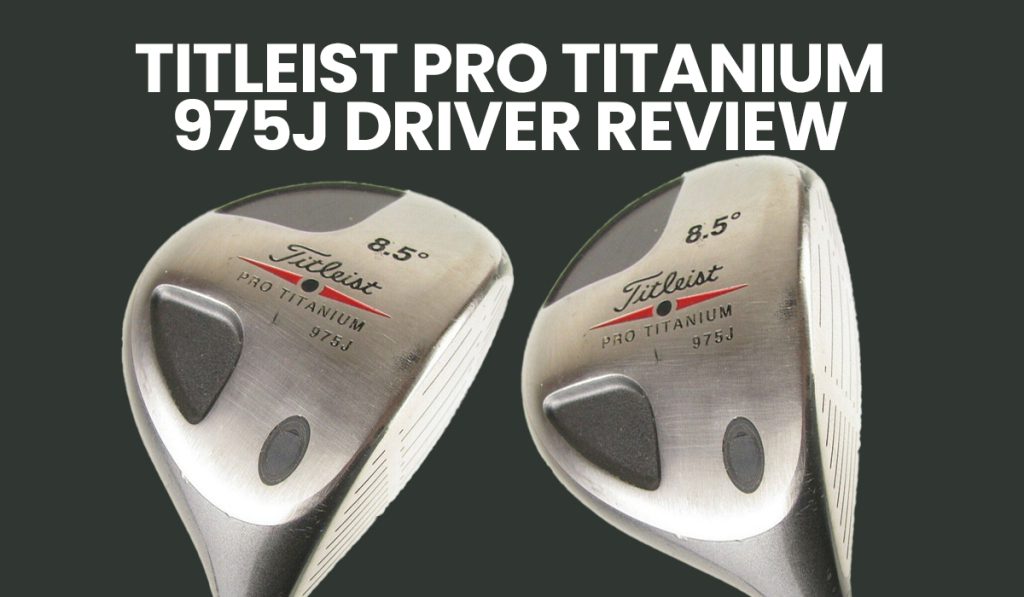
Titleist's First Thin-Faced Driver
The defining thing about the 975J wasn't its size (at 312cc it was only modestly bigger than the 975D). It was the face. Titleist moved to a thinner, variable-thickness titanium face designed to flex more at impact and produce faster ball speeds, a real departure from the more traditional feel of its predecessor. That trade-off shows up clearly in sound: reviewers consistently describe the 975J's metallic "ping" versus the 975D's wood-like "thwack," and most found the crisper sound inspired more confidence at address.
A Bridge to the 983K
The 975J was quickly surpassed by the 983K a couple of years later, but it mattered as the proof of concept: Titleist's first real step toward thin-faced, distance-focused driver design, in an era when the brand was still primarily known for tour-level control rather than raw distance.
Look, Sound and Feel
Sound
The thinner titanium face produces a crisper, more metallic "ping" at impact compared to the 975D's wood-like "thwack," a sound most contemporary reviewers said inspired more confidence.
Look
At 312cc, the head is only modestly larger than the 975D but carries a sleeker, more purposeful profile that hinted at where Titleist's driver design was heading.
Feel
The thin, variable-thickness face flexes more at impact than the 975D's, giving a livelier, more responsive feel that period reviewers linked directly to its added ball speed.
Pros
- Titleist's first genuinely thin-faced driver, a real distance step up from the 975D
- Confidence-inspiring sound and feel at impact
- Easy to work both directions according to period reviews
Cons
- Some players found the lower lofts unforgiving without a shaft change
- 312cc head is tiny by modern standards
- Long discontinued; collector/secondhand market only
Who Should Use It?
- Collectors interested in the driver that started Titleist's shift toward thin-faced distance design.
- Players who want a crisper sound and livelier feel than older cast-titanium heads.
- Better players comfortable working the ball with a lower-lofted, less forgiving head.
Suitability by handicap
| High handicap golfers | No |
| Mid handicap golfers | No |
| Low handicap golfers | Yes |
Features and Benefits
Design and Aesthetics
A modestly larger, sleeker evolution of the 975D's compact titanium profile, the first visual hint of Titleist's move toward thin-faced, distance-focused engineering.
Technology
Titleist's first thin, variable-thickness titanium face, designed to flex more at impact than the 975D's face for genuinely faster ball speeds.
Performance
A real step up in ball speed over the 975D, while retaining enough workability that period reviewers found it easy to shape shots both directions.
Distance
The thinner face was the direct driver of a real distance gain over the 975D, Titleist's first genuine move to compete on raw ball speed.
Forgiveness
Some players found the lower lofts unforgiving without a shaft change. This remained a better-player's head rather than a forgiveness-first design.
Flight Accuracy
Easy to work in both directions according to period reviews, giving skilled players real shot-shaping control.
Who Is This For Today?
Like the rest of Titleist's late-90s/early-2000s lineup, the 975J is a piece of driver history rather than a competitive option now. It's worth knowing as the moment Titleist's driver philosophy started shifting toward the thin-faced, distance-first designs that led to the 983K and everything after.
Conclusion
The 975J isn't as famous as the Tiger Slam-era 975D, but it's arguably more important technologically. It's the driver that proved Titleist could compete on ball speed, not just control.